
Volcanogenic Massive Sulphide (VMS) Deposit
In this tutorial, we explore modelling intrusions with a VMS deposit example. The VMS deposit requires the use of multiple non-conformal groups and careful assignment of overturned orientations to ensure the intrusion and subsequent phases of hydrothermal alteration are modelled correctly.
To begin with, let’s first model the source of the VMS deposit itself, a shallow intrusion into the surrounding seafloor. We use a set of contact points picked along two orthogonal cross-sections which depict a dome-shaped body. Since the intrusion does not conform to the surrounding seafloor, it is placed in its own group and requires at least one orientation. In fact, we use three orientations with one near each end of the curve to reinforce the idea that the intrusion is dome-shaped and not a closed sphere.
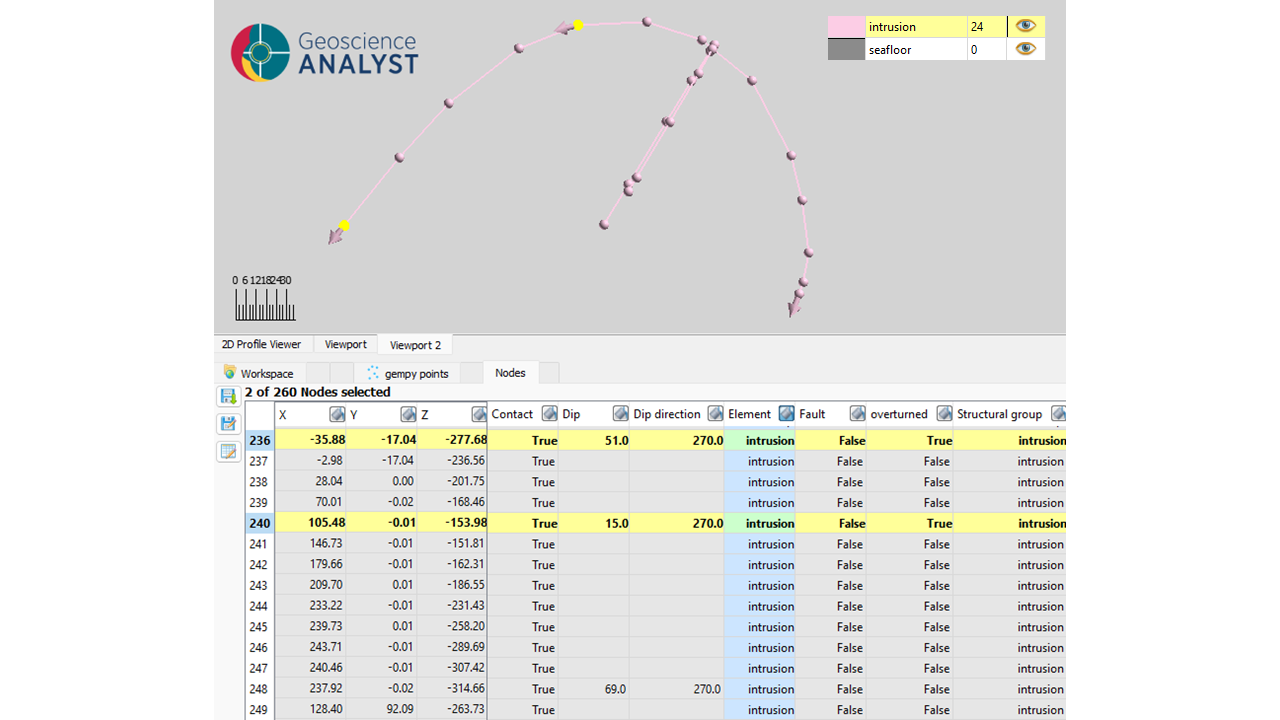
Fig. 58 Contact points and orientations for the intrusion. Overturned orientations are highlighted yellow.
While we only need to provide contacts to delineate the intrusion, adding an older unit below the intrusion in the history provides a proper label to the volume filled outside of the intrusion. Without it, this volume is simply labelled as GemPy’s default basement unit. In this example, we use the tag seafloor to represent material into which the intrusion is emplaced.
In order to model the intrusion correctly, we need to pay careful attention to the polarity of the orientations. We are often dealing with direction and dip orientation measurements, so to properly assign a polarity, we need to imagine the equivalent normal vectors.
For every surface, there are two possible normal vectors: one pointing outwards and one pointing inwards. However, direction and dip orientations implicitly choose one of these conventions. To visualize this, use the right-hand rule. By pointing the right index finger along strike and middle finger down dip, the thumb reveals the normal vector and its polarity.
To decide whether this polarity is correct, you must remember that contact points in GemPy mark the base of a unit. In other words, the normal vector is pointing in the direction of the younger unit. In the case of an intrusion into a volcanic seafloor, the younger unit is the intrusion and the normal vectors should be pointing inwards. In order to meet this convention for the half dome, it is necessary to mark the two leftmost orientations as overturned.
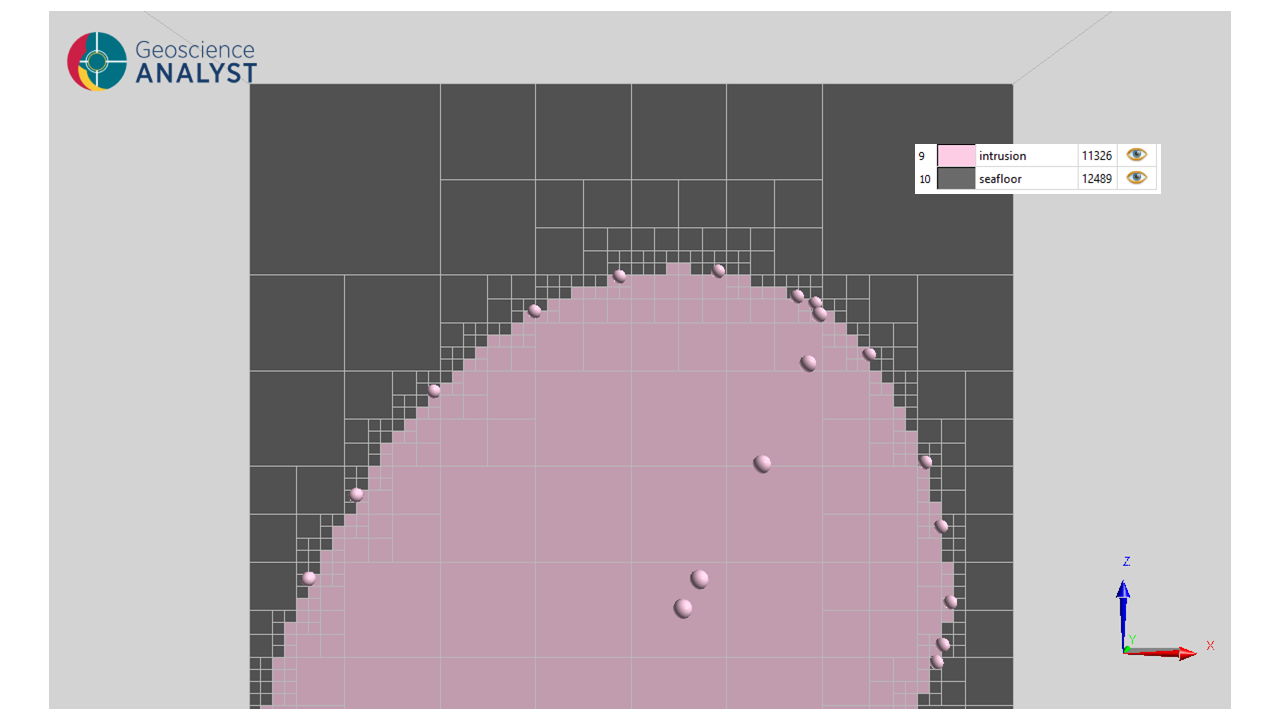
Fig. 59 Resulting model with the dome correctly marked as intrusion.
The rest of the VMS deposit model consists of a series of non-conformal groups stacked on top of one another. The history must be constructed carefully to ensure that the units are correctly modelled. For example, the chlorite-sericite and qz-sericite hydrothermal phases are younger than the carbonate unit resting below the massive sulphides, but older than the sulphides themselves.
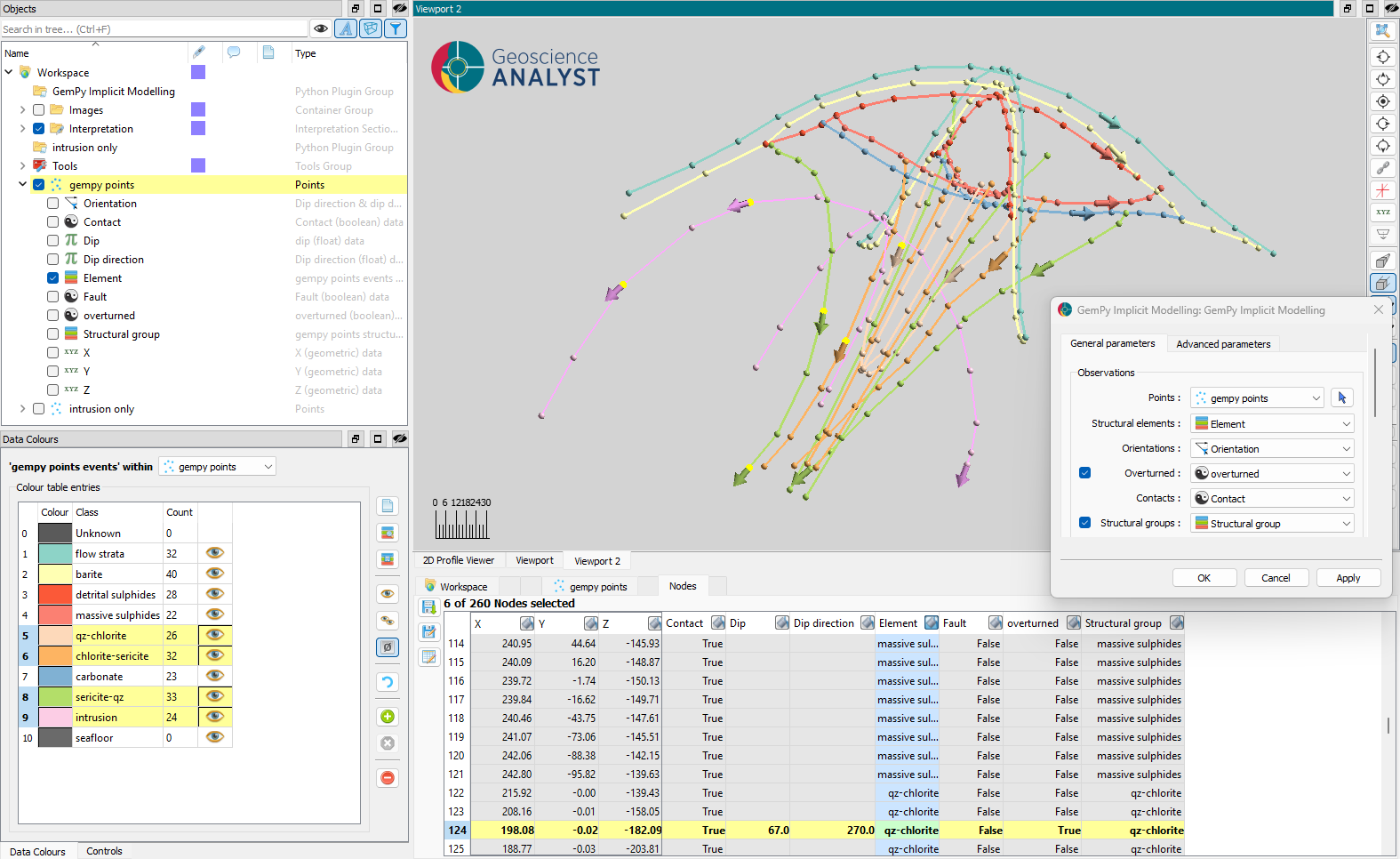
Fig. 60 Input data for the VMS model. Overturned orientations are highlighted yellow.
The same polarity strategy is used for the later hydrothermal phases. This requires marking the leftmost curves forming the vertical cones of hydrothermal alteration (sericite-qz, chlorite-sericite, and qz-chlorite) as overturned.
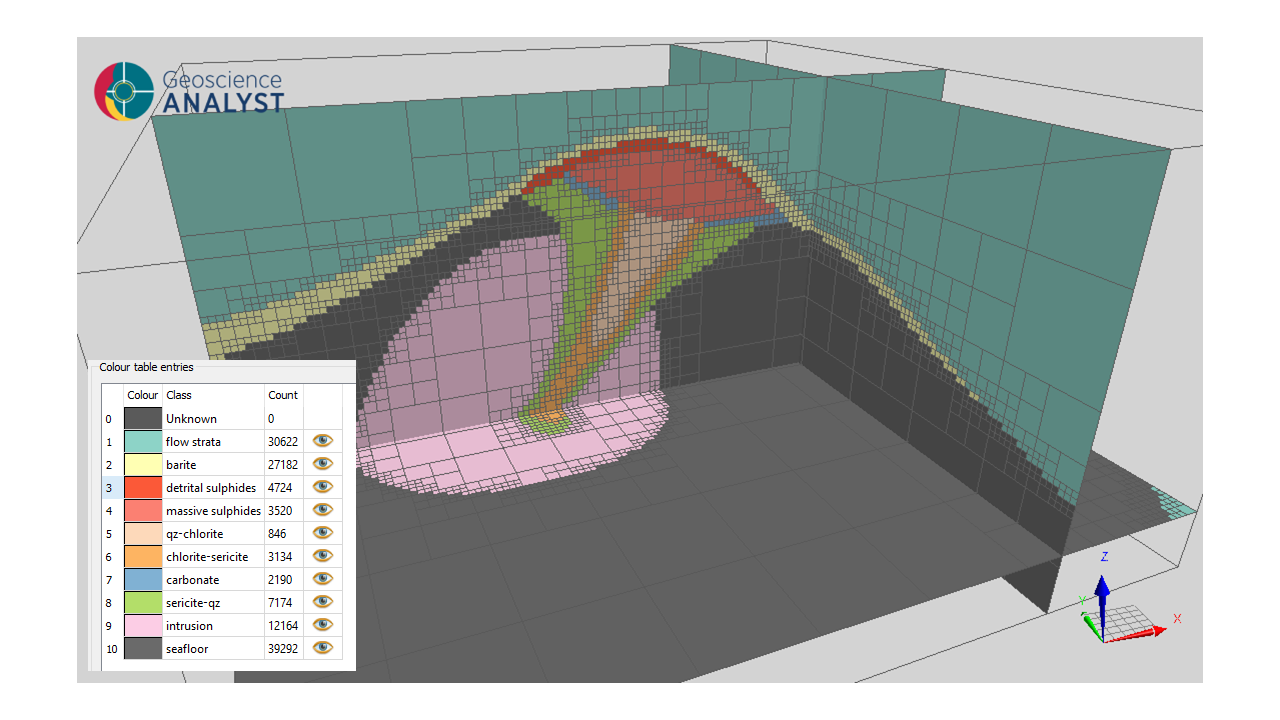
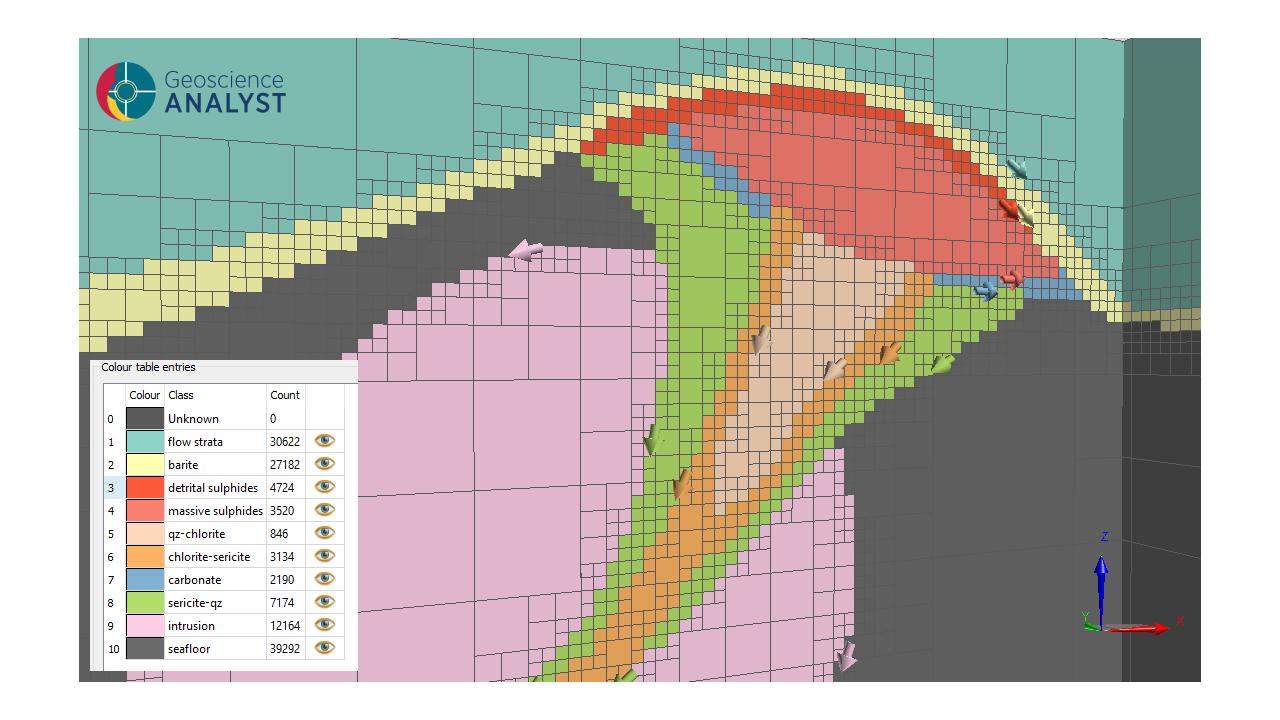
Fig. 61 Resulting VMS model.